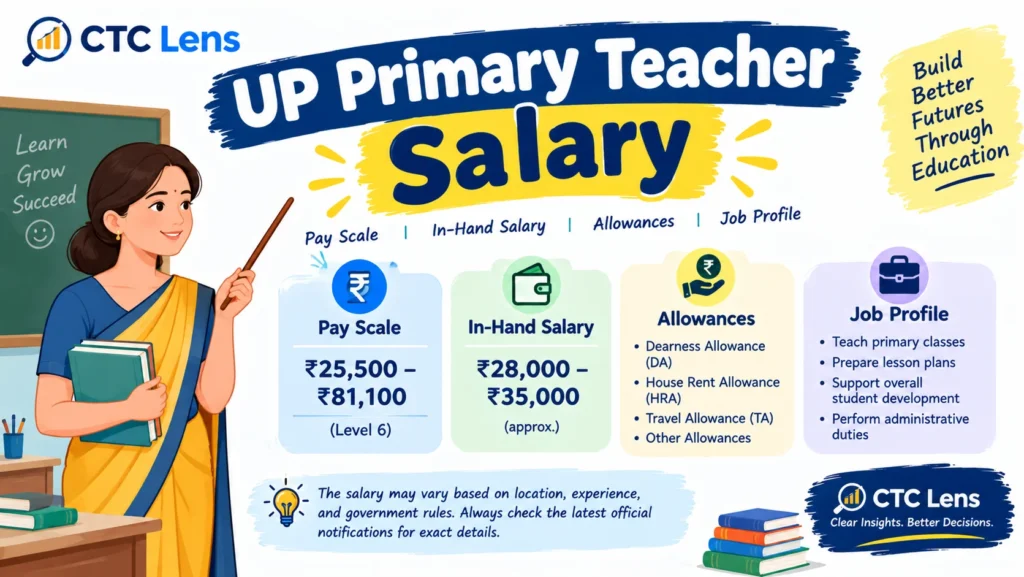

Quick answer: A UP Primary Teacher Salary (Assistant Teacher) starts at Pay Level 6 with a basic pay of ₹35,400 a month. After 60% DA, HRA and the 10% NPS deduction, the in-hand salary works out to about ₹53,800 in a Z-class posting and ₹59,500 in an X-class city, before any income tax.
Hindi mein: UP Primary Teacher ki salary kitni hoti hai? Shuruaat mein basic ₹35,400 aur in-hand lagbhag ₹54,000–₹59,500 per month.
The figures below follow the 7th Pay Commission matrix as used in the 2026 UPESSC recruitment notification. They use DA at 60%, the state rate from January 2026.
UP Primary Teacher Salary at a Glance
| Component | Detail |
|---|---|
| Post | Assistant Teacher, Primary (Basic Education / aided primary) |
| Pay level | Level 6 |
| Pay scale | ₹35,400 – ₹1,12,400 |
| Starting basic pay | ₹35,400 |
| DA (state, from Jan 2026) | 60% of basic = ₹21,240 |
| HRA | Depends on city class (modelled at 8% to 24% below) |
| NPS deduction | 10% of basic + DA = ₹5,664 |
| In-hand, first year | About ₹53,808 (8% HRA) to ₹59,472 (24% HRA) |
The Level 6 scale of ₹35,400–₹1,12,400 is what the 2026 UPESSC Assistant Teacher notification (Advt. 05/2026, 12,405 posts) lists for both posts, as reported by Careers360 and SarkariJobs. Confirm it on the official UPESSC portal.
Why You See Different Numbers: Pay Band, Grade Pay and Pay Level
Some pages quote “₹9,300–34,800 plus ₹4,200 grade pay”. Others say “Level 4” or “Level 5”. Here is how they connect.
- Under the older system, the scale was ₹9,300–34,800 with a grade pay of ₹4,200.
- The 7th CPC abolished grade pay and mapped that exact band and grade pay to Level 6, whose first cell is ₹35,400. The 7th CPC pay matrix shows this mapping.
- So the “UP primary teacher salary grade pay” figure of ₹4,200 and the “Level 6, ₹35,400” figure describe the same entry pay in two different systems.
- Upper primary teachers sit one step higher. Grade pay ₹4,600 maps to Level 7, which starts at ₹44,900.
Sources quoting Level 4 or 5 do not match the notification, so don’t rely on them.
Also Read: Drug Inspector Salary
How In-Hand Salary Is Calculated
In-hand salary is what reaches your bank account, and it is lower than gross pay. The calculator logic is:
- DA = 60% × Basic
- HRA = city-class % × Basic (8% / 16% / 24% used here as an indicative range)
- Gross = Basic + DA + HRA
- NPS = 10% × (Basic + DA)
- In-hand = Gross − NPS − GIS − income tax (if any)
NPS applies because UP brought teachers appointed after 1 April 2005 under the National Pension System, as reported by Hindustan Times. The contribution is not lost. It goes into your retirement corpus, but it does reduce your monthly credit.
Worked example (first year, ₹35,400 basic, Z-class posting):
- DA: ₹21,240
- HRA at 8%: ₹2,832
- Gross: ₹59,472
- NPS: ₹5,664
- In-hand: ₹53,808, before GIS and any tax
The same teacher in an X-class city at 24% HRA has a gross of ₹65,136 and an in-hand of ₹59,472.
UP Primary Teacher Salary 1 to 5 Years
Each year the basic moves to the next cell of Level 6. The step is roughly 3% a year, and I checked every cell against that. Figures use DA 60% and exclude GIS and income tax.
| Year of service | Basic | DA (60%) | NPS (10%) | In-hand (8% HRA) | In-hand (24% HRA) |
|---|---|---|---|---|---|
| 1 | ₹35,400 | ₹21,240 | ₹5,664 | ₹53,808 | ₹59,472 |
| 2 | ₹36,500 | ₹21,900 | ₹5,840 | ₹55,480 | ₹61,320 |
| 3 | ₹37,600 | ₹22,560 | ₹6,016 | ₹57,152 | ₹63,168 |
| 4 | ₹38,700 | ₹23,220 | ₹6,192 | ₹58,824 | ₹65,016 |
| 5 | ₹39,900 | ₹23,940 | ₹6,384 | ₹60,648 | ₹67,032 |
UP Primary Teacher Salary After 5, 10 and 20 Years
These figures assume one increment every year, no promotion and DA staying at 60%.
| After | Basic | In-hand (8% HRA) | In-hand (24% HRA) |
|---|---|---|---|
| Joining | ₹35,400 | ₹53,808 | ₹59,472 |
| 5 years | ₹41,100 | ₹62,472 | ₹69,048 |
| 10 years | ₹47,600 | ₹72,352 | ₹79,968 |
| 20 years | ₹64,100 | ₹97,432 | ₹107,688 |
Real slips will differ. DA changes twice a year, and promotion to headmaster or any career-progression benefit moves the basic faster than this table.
DA, HRA, NPS and Tax: What Moves UP Primary Teacher Salary
Dearness Allowance. UP raised the state DA from 58% to 60% effective January 2026, as reported by Angel One and Navbharat Live. Reports expect the central DA to reach about 63% from July 2026, but that depends on Cabinet approval. The state usually follows later, so treat 63% as a possibility rather than your current rate.
HRA. This is the biggest reason two teachers with the same basic take home different amounts. City class (X/Y/Z) sets the percentage, so a rural posting gets far less than a posting in Lucknow or Kanpur. Teachers who are allotted government accommodation do not get HRA.
Income tax. Annual gross at entry level is roughly ₹7–8 lakh. Whether TDS applies depends on the tax regime you declare, so check your own slip rather than assuming.
Also Read: Manav Sampada UP
Training, Probation and Primary vs Upper Primary
Some older guides mention a fixed stipend of about ₹7,300 a month during training or probation. The 2026 notification, as reported, states only the Level 6 pay. Check your appointment letter before assuming either.
| Primary (Classes 1–5) | Upper primary (Classes 6–8) | |
|---|---|---|
| Pay level | Level 6 | Level 7 |
| Starting basic | ₹35,400 | ₹44,900 |
UP Primary Teacher Salary and the 8th Pay Commission
- The 8th Pay Commission was constituted on 3 November 2025 with an 18-month mandate, and its report is expected around mid-2027.
- It is not implemented yet. The Cabinet said the effective date would “mostly” be 1 January 2026 (PTI via Greater Kashmir).
- The commission is a central body. UP has to adopt its recommendations separately for state teachers, so timing for UP is a state decision.
Here is arithmetic on a ₹35,400 basic, not a forecast. Press reports discuss fitment factors of about 2.28 to 2.86.
| Fitment factor | New basic (illustrative) |
|---|---|
| 2.28 | ₹80,712 |
| 2.57 (same as 7th CPC) | ₹90,978 |
| 2.86 | ₹101,244 |
Employee unions have asked for a much higher figure, 3.83. Treat any 8th CPC salary number as speculation until the commission reports. DA also resets under a new pay structure, so the final take-home will not be a simple multiplication.
Reading UP Primary Teacher Salary Slip (and Why a 2018 Slip Looks Different)
Whether you search for the UP primary teacher salary slip, a slip PDF or the 2018 format, use this checklist:
- Basic pay should match your Level 6 cell.
- DA percentage should match the current state rate.
- HRA should match your posting’s city class.
- NPS should be 10% of basic + DA.
- A 2018 slip shows the same ₹35,400 entry basic but a much lower DA, so the gross is far lower than today’s.
I couldn’t verify a single official download portal for primary-teacher slips. Your district BSA office or school DDO can tell you which one your payroll uses.
Common Mistakes About UP Primary Teacher Salary
- Treating basic as salary. Basic is about 55% of gross at entry level.
- Ignoring NPS. Gross figures on many sites overstate what you take home.
- Mixing up old and new systems. Grade pay and pay band are no longer used for pay fixation.
- Quoting 63% DA as current. It is a projection until approved.
Also Read: Panchayat Secretary Salary
FAQs About UP Primary Teacher Salary
What is the UP Primary Teacher Salary per month?
Basic starts at ₹35,400. In-hand is about ₹53,800–₹59,500 depending on HRA, before income tax.
Is the UP primary teacher salary the same in every district?
The basic is the same everywhere. HRA varies with city class, so take-home differs.
Is the pension old or new?
Teachers appointed after April 2005 are under NPS, not the old pension scheme.
Will the 8th Pay Commission raise my salary automatically?
Not automatically. The commission is central, and UP must adopt its pay structure for state teachers.
For more detailed information about salaries, income, and earnings across different professions, you can also check out our salary-focused resource, Salary Batao.