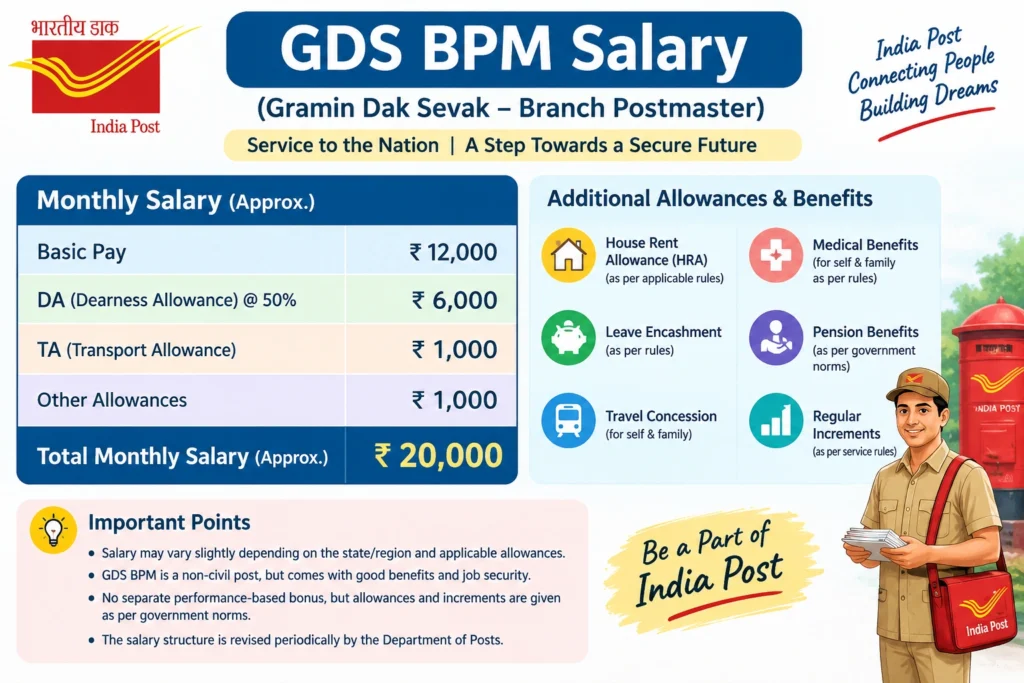

GDS BPM Salary in India Post ranges from a TRCA slab of ₹12,000 to ₹29,380 per month, with most BPMs actually taking home somewhere between ₹18,000 and ₹22,000 once Dearness Allowance is added in.
GDS BPM Post: Quick Stats Table
Here’s a snapshot of the role before we get into the salary specifics.
| Detail | Information |
|---|---|
| Post Name | Branch Postmaster (BPM) |
| Department | India Post, Department of Posts, Ministry of Communications |
| Scheme | Gramin Dak Sevak (GDS) |
| Pay Structure | Time Related Continuity Allowance (TRCA), not a standard fixed salary |
| TRCA Slab (4-hour duty) | ₹12,000 – ₹29,380 |
| TRCA Slab (5-hour duty) | Can extend up to ₹35,480 |
| Dearness Allowance (DA) | Applicable on TRCA, revised periodically (reported around 60% recently) |
| Annual Increment | 3%, subject to conditions under GDS Rules |
| Recruitment Coverage | Across 36 postal circles in India |
| Job Nature | Rural postal and banking service role, not a traditional Class 3 govt post |
Note: TRCA slabs, DA percentage, and increment conditions are revised periodically by the Department of Posts. Always cross-check the latest figures on the official India Post GDS recruitment portal (indiapostgdsonline.gov.in) before relying on them for financial planning.
What Is GDS BPM Salary, Really?
Let’s start with the basics. GDS BPM Salary isn’t structured like a typical government paycheck, and understanding this one distinction clears up almost every point of confusion aspirants run into.
Most government jobs pay a fixed basic salary plus grade pay. The GDS scheme works differently — Branch Postmasters and other Gramin Dak Sevaks are paid through something called Time Related Continuity Allowance, or TRCA for short. Instead of a flat monthly salary, TRCA is tied to how many hours a day the post requires, which is either 4 hours or 5 hours depending on the workload at that particular branch office.
India Post GDS BPM Salary: The Full Structure
Here’s where the details really matter. The India Post GDS BPM Salary package is built from a few clear components, and once you see them laid out, the whole system makes a lot more sense.
1. Base TRCA
This is the foundation figure — starting at ₹12,000 for a newly appointed BPM and capable of rising to ₹29,380 for 4-hour duty posts, or up to ₹35,480 for posts requiring 5 hours of daily duty.
2. Dearness Allowance (DA)
DA is applied on top of the base TRCA to help offset inflation, and it’s revised periodically by the government, similar to how DA works for other central government employees. Some recent reports place DA in the range of roughly 60% of TRCA, though this figure is adjusted from time to time.
3. Annual Increment
BPMs are entitled to a 3% annual increment, provided they meet the conditions laid out in the GDS Rules. This is one of the more reliable, predictable parts of the pay structure — it doesn’t require a promotion, just continued service under the applicable rules.
4. Additional Allowances
BPMs also receive a few smaller, role-specific allowances, including an Office Maintenance Allowance and Fixed Stationery Charges, on top of the core TRCA and DA.
Here’s a simplified table putting it all together:
| Component | Approximate Amount (Monthly) |
|---|---|
| Base TRCA (starting) | ₹12,000 |
| Base TRCA (maximum, 4-hour duty) | ₹29,380 |
| Base TRCA (maximum, 5-hour duty) | ₹35,480 |
| Dearness Allowance (DA) | Applied as a percentage of TRCA, revised periodically |
| Office Maintenance Allowance | ₹100 per month |
| Fixed Stationery Charges | ₹25 per month |
| Approximate Gross Salary (with DA) | ₹18,000 – ₹22,000+ for most starting BPMs |
Post Office GDS BPM Salary Per Month: What Actually Lands In Hand
This is the question most aspirants really care about. GDS BPM Salary Per Month, in real, practical terms, generally works out to somewhere between ₹18,000 and ₹22,000 for someone starting out, once DA is factored into the base TRCA.
Here’s the thing that trips a lot of people up: the ₹29,380 figure you’ll see quoted everywhere is the top end of the TRCA slab, reached only after years of increments — not the starting take-home pay. A fresh BPM starts much closer to the ₹12,000 base, and DA on top of that base is what brings the realistic in-hand figure up into the high teens or low twenties.
The Post Office GDS BPM Salary also varies slightly by posting circle, since local conditions and specific branch requirements can shift the working-hour classification (4 hours versus 5 hours), which directly affects the applicable TRCA slab.
| Duty Hours | Base TRCA Range | Approx. Gross With DA |
|---|---|---|
| 4 Hours | ₹12,000 – ₹29,380 | ₹18,000 – ₹22,000 (starting) |
| 5 Hours | Up to ₹35,480 | Can reach above ₹55,000 with full increments and DA |
GDS BPM Salary After 3 Years: What Growth Looks Like
Let’s talk about the part every aspirant wants clarity on: GDS BPM Salary After 3 Years doesn’t stay frozen at the starting figure. With the 3% annual increment applied consistently, plus periodic DA revisions, the gross monthly figure climbs steadily.
Roughly speaking, over 3 years of service, three rounds of the 3% annual increment push the base TRCA up several notches, and combined with any DA rate increases during that period, the gross salary can move up noticeably from the starting figure. It won’t feel like a dramatic jump in any single year, but it’s a steady, government-style climb — predictable and reliable, even if it’s not fast.
| Stage | Approximate Base TRCA | Approximate Gross Salary (with DA) |
|---|---|---|
| Starting (Year 1) | ₹12,000 | ₹18,000 – ₹20,000 |
| After 3 Years | ₹13,000 – ₹14,000+ | ₹20,000 – ₹24,000+ |
| Long-Term (Higher Slab, 5-Hour Duty) | Up to ₹35,480 | Can extend well above ₹50,000 with DA and full increments |
GDS BPM Salary Slip 2026: What It Actually Shows
If you’re a newly selected BPM, your GDS BPM Salary Slip 2026 will generally break down your pay into a few clear line items, rather than the more complex breakdown you might see on a regular government payslip. Typically, you’ll find:
- Base TRCA for the month, based on your duty-hour classification
- DA amount, calculated as the applicable percentage of your base TRCA
- Office Maintenance Allowance and Stationery Charges, where applicable
- Any deductions, such as those related to GDS Gratuity or Service Discharge Benefit Scheme contributions
- Net payable amount, which is what actually gets credited to your account
GDS BPM Salary After 8th Pay Commission: What To Expect
This is one of the most frequently searched questions right now, and it deserves an honest answer. GDS BPM Salary After 8th Pay Commission is a topic surrounded by anticipation, since the current TRCA structure is still based on the 7th Pay Commission framework.
Here’s the important clarification: GDS employees are paid through TRCA, not the standard pay matrix used for regular central government employees, so it isn’t automatically guaranteed that the 8th Pay Commission’s recommendations will apply to GDS posts in exactly the same way. Multiple sources indicate that any revision to GDS pay following the 8th Pay Commission would likely come through a separate review process specific to the GDS scheme, rather than a direct one-to-one adoption of the new pay matrix.
GDS BPM vs. ABPM/Dak Sevak: How The Pay Compares
To put the BPM post in perspective, here’s how it stacks up against the other GDS categories.
| Post | TRCA Slab (4-Hour Duty) | Annual Package (Approx.) |
|---|---|---|
| Branch Postmaster (BPM) | ₹12,000 – ₹29,380 | Around ₹1,44,000 |
| Assistant Branch Postmaster (ABPM) | ₹10,000 – ₹24,470 | Around ₹1,20,000 |
| Dak Sevak | ₹10,000 – ₹24,470 | Around ₹1,20,000 |
Perks And Benefits Beyond The Paycheck
TRCA and DA aren’t the whole story. The BPM post comes with a few additional benefits worth factoring in:
- GDS Gratuity — a benefit tied to length of service under GDS Rules.
- Service Discharge Benefit Scheme — a savings-linked benefit available to GDS employees.
- Paid leave entitlements, as per applicable GDS Rules.
- Office Maintenance and Stationery Allowances, covering small operational costs tied to running the branch office.
- Rural posting stability — while not a traditional pensionable Class 3 post, it offers a steady, recognized government-linked role, often close to home for candidates from rural backgrounds.
Related Terms You Should Know
- TRCA (Time Related Continuity Allowance) — the pay structure used for GDS posts, tied to working hours rather than a fixed monthly salary.
- Dearness Allowance (DA) — a cost-of-living adjustment applied as a percentage of TRCA, revised periodically.
- Gramin Dak Sevak (GDS) — the overarching scheme under which BPM, ABPM, and Dak Sevak posts fall.
- GDS Gratuity — a service-length-based benefit available to GDS employees.
- Service Discharge Benefit Scheme — a savings-linked benefit scheme for GDS employees.
- 8th Pay Commission — the upcoming central pay revision body, whose impact on GDS-specific TRCA structures is not yet officially confirmed.
- Postal Circle — one of 36 regional divisions of India Post, which can influence local posting conditions and duty-hour classification.
Conclusion: The Bottom Line On GDS BPM Salary
Here’s the short version of everything above. GDS BPM Salary is based on a TRCA slab of ₹12,000 to ₹29,380 for 4-hour duty posts, extending up to ₹35,480 for 5-hour duty posts, with Dearness Allowance added on top. Most starting BPMs can realistically expect a gross monthly figure somewhere between ₹18,000 and ₹22,000, and GDS BPM Salary After 3 Years shows steady, predictable growth through the standard 3% annual increment, along with periodic DA revisions.
Add in gratuity benefits, the Service Discharge Benefit Scheme, and the genuine community standing that comes with running a rural branch post office, and it’s easy to see why this remains a solid, stable opportunity for candidates across India’s postal circles — even if it’s structured quite differently from a typical government paycheck.
Read More:
- CGDA Auditor Salary
- SSC MTS Salary
- Loco Pilot Salary In India
- WBP Constable Salary
- Marcos Commando Salary
- Vidyut Sahayak Salary
Frequently Asked Questions
1. What is the starting GDS BPM Salary?
The starting base TRCA is ₹12,000 per month, with gross salary (after DA) typically working out to somewhere between ₹18,000 and ₹20,000 for a newly appointed BPM.
2. What is India Post GDS BPM Salary based on?
It’s based on the Time Related Continuity Allowance (TRCA) system, which ties pay to duty hours (4 or 5 hours daily) rather than a fixed government pay matrix.
3. How much is GDS BPM Salary After 3 Years?
After roughly 3 years, with the standard 3% annual increment applied each year, gross salary generally rises to somewhere in the ₹20,000 to ₹24,000 range, depending on the applicable DA rate at the time.
4. Will GDS BPM Salary After 8th Pay Commission increase automatically?
This isn’t officially confirmed yet. Since GDS posts use TRCA rather than the standard pay matrix, any 8th Pay Commission impact would likely require a separate departmental review — track official India Post announcements for confirmed updates.
5. What does a GDS BPM Salary Slip 2026 typically show?
It generally shows base TRCA, applicable DA, small allowances like Office Maintenance and Stationery Charges, any applicable deductions, and the final net payable amount.
6. Is GDS BPM Salary Per Month the same across all postal circles?
Not exactly. While the TRCA slab structure is standard, the actual duty-hour classification (4 vs. 5 hours) can differ by branch post office, which affects the achievable salary range.
For more detailed information about salaries, income, and earnings across different professions, you can also check out our salary-focused resource, Salary Batao.