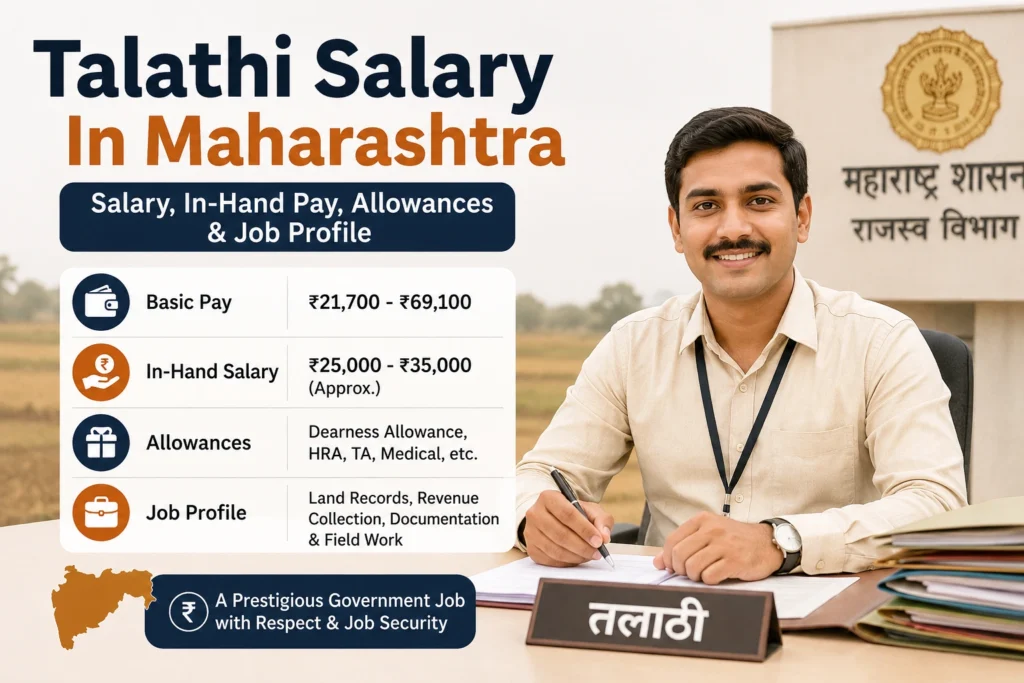

Talathi Salary In Maharashtra ranges from ₹25,500 to ₹81,100 in basic pay, with most fresh Talathis taking home around ₹28,000 to ₹40,000 a month after allowances and deductions.
Talathi Post: Quick Stats Table
Before we dig into the salary details, here’s a snapshot of the Talathi post itself, so you know exactly what role we’re talking about.
| Detail | Information |
|---|---|
| Post Name | Talathi (Village Revenue Officer) |
| Department | Revenue and Forest Department, Government of Maharashtra |
| Recruiting Body | Maharashtra Public Service Commission / Revenue Department Board |
| Post Category | Group C, Class 3 Government Employee |
| Pay Level | Level 4 / Pay Level S8 (as per 7th Pay Commission) |
| Pay Scale | ₹25,500 – ₹81,100 |
| Grade Pay | ₹2,400 |
| Pay Band | Pay Band-3 equivalent (₹5,200 – ₹20,200 legacy scale) |
| Probation Period | 2 years (basic pay only during probation) |
| Job Nature | Permanent government job with pension benefits (NPS) |
Note: Exact figures for allowances and gross pay are periodically revised by the state government. Always verify the latest Government Resolution (GR) on the official Maharashtra Revenue Department or MPSC website before relying on these numbers for financial planning.
What Is Talathi Salary In Maharashtra, Really?
Let’s start simple. Talathi Salary In Maharashtra isn’t just one flat number — it’s a combination of basic pay, grade pay, and several allowances, minus a few standard deductions. Think of it like a thali: the basic pay is your rice, and the allowances are all the different side dishes that make the full meal.
A Talathi is the local revenue officer at the village level, responsible for maintaining land records, updating the famous 7/12 extract, tracking crop data, and generally being the go-to government representative for anything land-related in a village. It’s a respected, stable Class 3 government post — and the pay reflects that stability, even if it doesn’t make headlines for being extravagant.
Maharashtra Talathi Salary: The Full Breakdown
Here’s where it gets interesting. The Maharashtra Talathi Salary structure has several moving parts, and understanding each one helps you know exactly what lands in your bank account.
1. Basic Pay
Every Talathi starts at the bottom of the pay scale — ₹25,500 per month. This is the foundation everything else is built on.
2. Grade Pay
On top of basic pay, Talathis receive a Grade Pay of ₹2,400, which reflects the seniority level of the post within the Group C category.
3. Dearness Allowance (DA)
DA is meant to offset inflation and is revised periodically by the state government. It’s typically calculated as a percentage of basic pay, and depending on the current rate, it can add anywhere from roughly one-third to about half of the basic pay back into your salary.
4. House Rent Allowance (HRA)
HRA depends on where you’re posted. Since most Talathis work in rural tehsils rather than big cities, HRA is usually on the lower end of the scale compared to someone posted in Mumbai or Pune.
5. Deductions
A portion of the salary goes toward the National Pension System (NPS) and other standard government deductions, which is why the in-hand salary is always a bit lower than the gross salary.
Here’s a simplified table putting it all together:
| Component | Approximate Amount (Monthly) |
|---|---|
| Basic Pay | ₹25,500 |
| Grade Pay | ₹2,400 |
| Dearness Allowance (DA) | ₹8,500 – ₹12,750 (varies by rate) |
| House Rent Allowance (HRA) | ₹2,000 – ₹6,500 (varies by posting location) |
| Gross Salary (approx.) | ₹40,000 – ₹44,000 |
| Deductions (NPS, PF, etc.) | ₹3,000 – ₹6,500 |
| In-Hand Salary (approx.) | ₹28,000 – ₹40,000 |
Talathi Salary After 7th Pay Maharashtra
This is one of the most searched questions among aspirants, so let’s answer it directly. Talathi Salary After 7th Pay Maharashtra refers to how the post’s pay is structured under the 7th Pay Commission recommendations, which most Indian states, including Maharashtra, have adopted for their government employees.
Under the 7th Pay Commission, the Talathi post falls under Pay Level 4 (sometimes referenced as Pay Level S8 depending on the source), with the pay scale of ₹25,500 to ₹81,100. This replaced the older, more complicated pay band and grade pay system with a single, cleaner pay matrix — making it easier to understand exactly where you stand and how your salary grows over time.
In simple terms: before the 7th Pay Commission, salary calculations involved separate pay bands and grade pay figures that could get confusing fast. Now, everything sits on one clear ladder, and Talathis simply move up a step with each increment, making annual pay hikes much more transparent.
Talathi Salary After 5 Years: What Growth Looks Like
Here’s the part most aspirants really want to know: Talathi Salary After 5 Years doesn’t stay stuck at the starting figure. Government salaries typically include annual increments, and on top of that, DA rates get revised periodically, which pushes up the gross salary even without a promotion.
Roughly speaking, after about 5 years of service, a Talathi’s basic pay moves up several notches within the pay matrix through yearly increments, and combined with periodic DA hikes, the gross salary can comfortably rise well above the starting figure. It’s not an overnight jump, but it’s a steady, dependable climb — exactly the kind of growth government jobs are known for.
StageApproximate Basic PayApproximate Gross SalaryStarting (Year 1, Probation)₹25,500Basic pay onlyAfter Probation (Year 2-3)₹26,300 – ₹27,000₹35,000 – ₹40,000After 5 Years₹28,000 – ₹30,000+₹40,000 – ₹48,000+Long-Term (15-20+ Years)Higher pay matrix levelsCan extend well beyond ₹1 lakh with DA revisions and promotions
Talathi Salary vs. Other Similar Government Posts
To put things in perspective, here’s how Talathi Salary compares to a couple of other entry-level Maharashtra government posts at a similar level.
| Post | Pay Scale | Approx. In-Hand Salary |
|---|---|---|
| Talathi | ₹25,500 – ₹81,100 | ₹28,000 – ₹40,000 |
| Gram Sevak | Similar Level 4 range | Comparable, slightly variable by department |
| Police Constable (Maharashtra) | Similar Level 4-5 range | Comparable, with different allowance structure |
| Clerk (Maharashtra Secretariat) | Similar Level 4 range | Comparable, office-based allowances |
Perks and Benefits Beyond The Paycheck
Salary is only part of the story. The Talathi post comes with several non-cash benefits that genuinely add value:
- Job security — it’s a permanent government position, not a contract role.
- Pension benefits — coverage under the National Pension System (NPS).
- Medical and other standard government allowances, subject to current policy.
- Local authority and respect — a Talathi holds real administrative importance at the village level.
- Promotion pathway — departmental promotions and MPSC exams can lead to roles like Circle Officer, Tahsildar, and even Deputy Collector over a career.
How Talathi Salary Is Actually Calculated: A Walkthrough
Numbers on a table are useful, but seeing exactly how they add up makes everything click. Let’s walk through a simplified example of how Talathi Salary In Maharashtra gets calculated for a newly appointed Talathi posted in a rural tehsil.
Step 1: Start with Basic Pay. Every calculation begins with the base figure of ₹25,500. This never changes based on posting location — it’s fixed by the pay matrix.
Step 2: Add Dearness Allowance (DA). DA is calculated as a percentage of basic pay, and this percentage is revised by the state government from time to time. If DA is around 34%, that adds roughly ₹8,670 on top of the basic pay.
Step 3: Add House Rent Allowance (HRA). HRA depends entirely on where the Talathi is posted. Rural postings typically fall in the lowest HRA bracket, while urban postings near cities like Mumbai or Pune fall into higher brackets. For most Talathis working in villages, this adds anywhere from roughly ₹2,000 to ₹2,700.
Step 4: Add other minor allowances, if applicable, such as travel allowance, depending on department policy.
Step 5: Subtract deductions. From the gross figure, standard deductions like NPS contribution and professional tax are subtracted. These typically account for roughly ₹3,000 to ₹6,500 depending on the exact basic pay slab.
Final Step: In-Hand Salary. After all of this, the number that actually lands in the bank account each month is the in-hand salary — generally somewhere in the ₹28,000 to ₹40,000 range for a fresh Talathi, exactly matching the figures in the stats table above.
Why Talathi Salary In Maharashtra Varies By Posting
Here’s something a lot of aspirants don’t realize until after they’ve cleared the exam: Maharashtra Talathi Salary can look slightly different depending on where you’re posted, even though the basic pay and grade pay stay exactly the same across the state.
The variation mostly comes from HRA. A Talathi posted in a small village will receive a lower HRA percentage than one posted closer to a bigger town or city, simply because rental costs differ so much between the two. It’s a fair system in that sense — it’s meant to reflect actual cost of living rather than paying everyone the same flat housing allowance regardless of location.
Talathi Salary Compared To Cost Of Living In Rural Maharashtra
One thing that often gets missed in salary discussions is context. A Talathi Salary of ₹28,000 to ₹40,000 might not sound like a huge number in isolation, but it needs to be viewed against the cost of living in the areas where most Talathis actually work.
In rural Maharashtra, housing costs, daily expenses, and general cost of living tend to be significantly lower than in metro cities like Mumbai or Pune. A government salary that might feel modest in an expensive city can go a lot further in a smaller town or village, especially when paired with the long-term security and pension benefits that come with the post.
Related Terms You Should Know
- 7/12 Extract — the land ownership document a Talathi is responsible for maintaining.
- Pay Matrix Level — the salary ladder structure introduced under the 7th Pay Commission.
- Grade Pay — an additional fixed component added to basic pay, reflecting seniority.
- Dearness Allowance (DA) — a cost-of-living adjustment revised periodically by the government.
- National Pension System (NPS) — the pension scheme applicable to Talathi and other government employees.
- MPSC — Maharashtra Public Service Commission, the body overseeing several government recruitment exams, including promotional exams for Talathis.
- Circle Officer / Tehsildar — higher administrative posts a Talathi can grow into through promotion or further exams.
Conclusion: The Bottom Line On Talathi Salary In Maharashtra
Here’s the short version of everything above. Talathi Salary In Maharashtra starts on a pay scale of ₹25,500 to ₹81,100, with most fresh recruits taking home somewhere between ₹28,000 and ₹40,000 a month once allowances and deductions are factored in. Under the 7th Pay Commission, this structure is clearer and more predictable than older pay systems, and Talathi Salary After 5 Years shows steady, reliable growth through annual increments and periodic DA revisions.
Add in the job security, pension benefits, and a genuine promotion pathway toward roles like Circle Officer or Tehsildar, and it’s easy to see why this remains one of the most sought-after entry-level government posts in rural Maharashtra. It’s not a flashy paycheck — but it’s a dependable one, with real room to grow.
Read More:
- CGDA Auditor Salary
- SSC MTS Salary
- Loco Pilot Salary In India
- WBP Constable Salary
- Marcos Commando Salary
- Vidyut Sahayak Salary
Frequently Asked Questions
1. What is the starting Talathi Salary In Maharashtra?
The starting basic pay is ₹25,500 per month, with gross salary (before deductions) typically reaching around ₹40,000 once allowances are added.
2. What is Talathi Salary After 7th Pay Maharashtra based on?
It’s based on the 7th Pay Commission’s pay matrix system, placing the Talathi post at Pay Level 4 with a scale of ₹25,500 to ₹81,100.
3. How much is Talathi Salary After 5 Years?
After roughly 5 years, basic pay generally rises through annual increments, pushing gross salary toward approximately ₹40,000 to ₹48,000, depending on the applicable DA rate at the time.
4. Does Talathi Salary include HRA?
Yes, HRA is included, though the amount depends on posting location — rural postings typically receive a lower HRA percentage than urban ones.
5. Is there a probation period that affects Maharashtra Talathi Salary?
Yes, selected candidates undergo a 2-year probation period during which they generally receive basic pay only, without the full range of allowances.
6. Can Talathi Salary grow through promotion?
Yes, Talathis can be promoted departmentally or move up through further MPSC exams to roles like Circle Officer, Tahsildar, and eventually Deputy Collector, each carrying a higher pay scale.